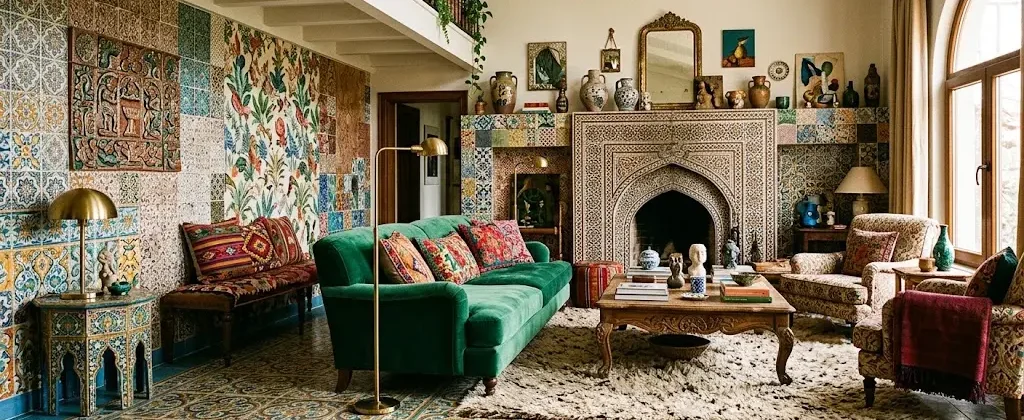
Materials and Surfaces in the Transition from Minimalism to Maximalism
The “less is more” motto that has surrounded us in recent years, along with those pristine, snow-white spaces, is slowly losing its appeal. We may have spent 2025 embracing “warm minimalism”—a calmer aesthetic dominated by earth tones—but 2026 is shaping up to be the year of bold, character-filled spaces that completely break the rules. Research in the world of interior design confirms this: 39% of designers cite maximalism, while 38% point to the eclectic style as the main trend for the coming period.
So what happened that suddenly led us to move from such simple lives to colorful, multi-layered homes?
Sterile Environment Fatigue and the Search for “Dopamine” at Home
The answer is actually very human: We’ve grown tired of it. Those overly sterile, featureless homes—which began with the pandemic and persisted for years, looking as if they’d jumped right out of a catalog—gradually began to feel less like living spaces and more like emotionless exhibition halls. We’ve stopped hiding our own memories, the objects we’ve collected and cherished, and the colors we love.
It was right during this process that Dopamine Décor entered our lives. It’s a decorating philosophy that brightens our spirits the moment we walk in, makes us feel good, and triggers our happiness hormones. This isn’t the overwhelming clutter that comes to mind when people hear the terms “maximalism” or “eclecticism.” It’s a layered design language where elements from different eras, seemingly contrasting textures, and bold colors are layered on top of one another with a certain balance.
What Holds a Maximalist Space Together: Richness of Surface
If you want to capture a maximalist vibe, simply painting the wall a bold color or throwing in a few colorful throw pillows isn’t enough. The true character of a space lies in the surfaces that catch the eye and that you touch.
Mass-produced, uniform, identical finishing materials are completely at odds with the spirit of this style. Because it’s a maximalist space;
- With patterned ceramics that tell a story,
- With stones that give you that natural feel when you touch them,
- It is created through contrasting finishes that do not compete with one another but reveal their character when placed side by side.
Combining the warmth of wood on the floor with the raw texture of concrete, and blending a nostalgic pattern on the wall with a modern color, gives the space that much-sought-after depth. Here, the surfaces are not merely a simple backdrop; they are the main protagonists of the space.
When Mass Production Falls Short: Handicrafts and Artisanship
The greatest shortcoming of mass-produced goods is their perfection; for what is perfect is generally soulless. It is nearly impossible to establish the sincere and emotional connection that maximalism seeks through mass-produced items.
Last week’s “Craft Revival: The True Value of Handcrafted Art” , the subtle variations in tone on a tile crafted by a master artisan, the delicate texture of the pattern, or the brushstrokes all lend the space an inimitable identity. Tiles produced using traditional methods and handcrafted surfaces are becoming the strongest complement to this free-spirited design philosophy of 2026.
Project Your Own Story onto Surfaces
If you, too, want to step beyond the boundaries of minimalism in your home or project and create an atmosphere that reflects your own personality, you can start the transformation with the floor you walk on and the walls you touch.
Karoistanbul’s handmade ceramics, cement tile collectionsoffer the rich palette of materials you need for maximalist and eclectic designs. Browse the Karoistanbul Collections to discover unique surfaces that will add character to your space.
Frequently Asked Questions (FAQ)
How can you strike a balance to avoid clutter in maximalist decor?
Maximalism isn’t about piling up objects; it’s about combining the right layers. To avoid clutter, a common color palette should be established for the space. For example, if you choose dynamic, patterned floor tiles, you can achieve visual balance by selecting one of the primary colors from those tiles as the background color for the walls and furniture.
Are patterned tiles and maximalist surfaces used in small spaces?
Yes, using the right surfaces in small spaces adds depth and character to the area. In narrow spaces like bathrooms or entryways, you can create a stylish and eye-catching atmosphere without making the space feel cramped by choosing patterned concrete or ceramic tiles for the floor or a single accent wall.
Why should handmade and textured tiles be preferred in maximalist design?
Maximalist design draws inspiration from lived-in character and originality. While mass-produced items offer a cold and generic appearance, the natural variations in texture, tonal transitions, and brushstrokes found in handmade tiles add a depth that shifts with the light, infusing the space with the spirit of craftsmanship.